If you're shopping lift kits and truck accessories in Reading, start by deciding whether you need a leveling upgrade or a full suspension lift. A leveling upgrade corrects factory rake and keeps daily manners intact, while a suspension lift adds clearance, wheel travel, and larger tire fitment. You'll want exact year, trim, drivetrain, and suspension details to verify Rough Country fitment. Budget for tires, alignment, and accessories like steps, lights, or liners—you'll see how the right setup comes together.
Main Points
- Choose a leveling kit to remove factory rake while keeping near-stock performance and fitting slightly larger tires for daily driving.
- Select a suspension lift to achieve more ground clearance, wheel travel, and off-road performance, understanding that handling and steering will change.
- Check exact fitment with your truck's year, make, model, drivetrain, trim, cab, bed, and suspension package before buying Rough Country parts.
- Select lift height and shock type based on your use, including commuting, mixed trail driving, towing, or heavier off-road travel.
- Reserve money for beyond the kit cost itself, with costs for alignment, labor, wheels, tires, shocks, and supporting accessories like steps, lights, and liners.
Comparing Suspension Lift Kits and Leveling Kits
Since both upgrades affect your truck's appearance, suspension lift kits and leveling kits address distinct problems and deliver different results. A leveling kit usually raises the front to match the rear, correcting factory rake with little change to geometry, ride height, and drivability. You use one if you want a cleaner profile and space for bigger tires.
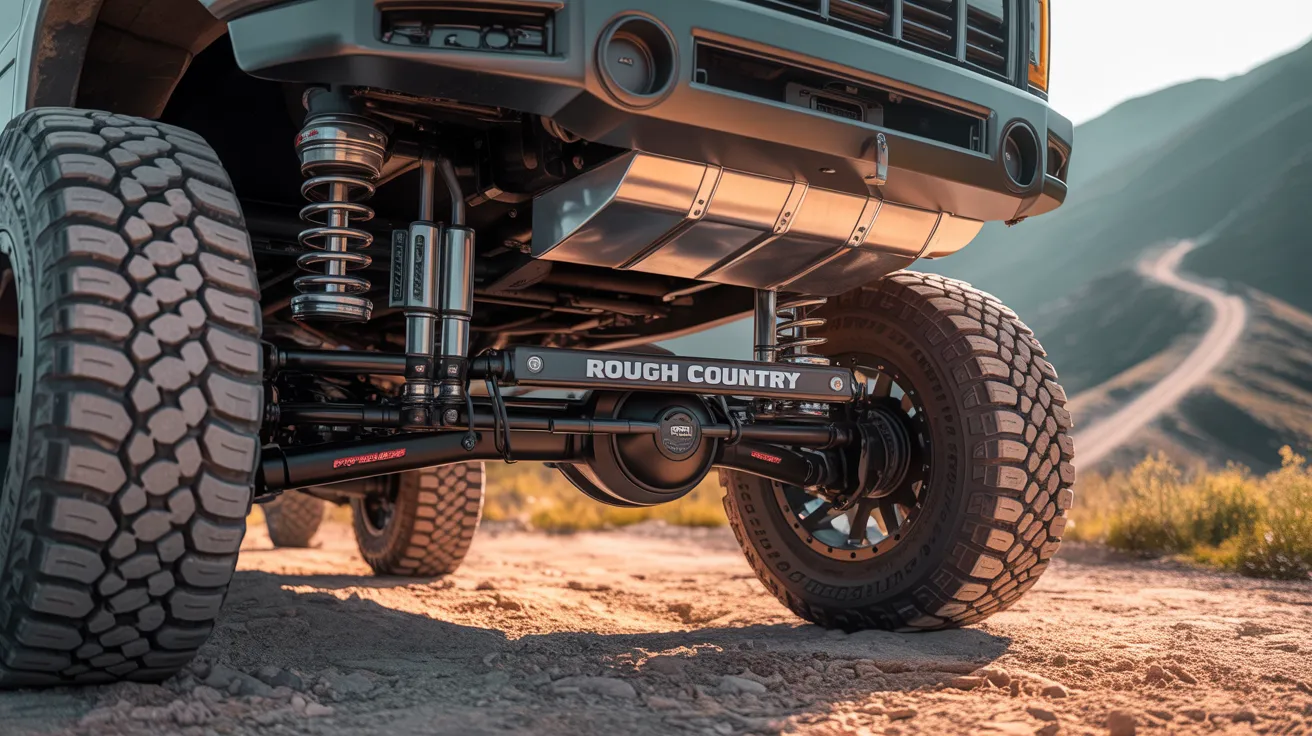
A suspension lift kit raises the whole truck and changes key components to create more clearance and suspension travel. You'll see larger improvements in ride height, off-road capability, and tire fitment, but helpful information you should expect handling changes, steering differences, and a raised center of gravity. If you want subtle visual improvement, use a leveling kit. If you need real clearance and articulation, use a suspension lift and design the supporting modifications around your use case.
Determine which Rough Country lift kit is right your truck.
Start by gathering your truck's year, brand, and model, drivetrain, and your usage goals, since Rough Country designs lift kits based on specific platform requirements and performance objectives. This information reveals which brackets, struts, spacers, crossmembers, and hardware attach properly without fitment or alignment problems.
Next, verify OEM ride height, cabin and cargo bed layout, axle type, and whether your truck has 2WD, 4WD, or adaptive suspension. Rough Country fitment guides help with this step, but you still need to check fitment accuracy against trim-level parts and factory package differences. A kit that fits a Silverado 1500 may not fit a Trail Boss, and a Ram with air suspension necessitates different accommodations than a vehicle with coil springs. Once you verify fitment first, you sidestep unexpected problems, parts conflicts, and return delays.
Which Rough Country lift kit suits your driving preferences?
Pair the kit with your actual driving habits, and you'll enjoy enhanced ride quality, lasting performance, and tire space without paying for capability you won't use. If commuting is your main activity, choose a light leveling kit from Rough Country or a 2 to 3.5 inch lift kit designed for commuting comfort and predictable steering geometry.
If you divide time between road and off-road use, upgrade to a lifted suspension with improved shocks and adjusted control arm geometry. You'll gain stronger off road handling, superior articulation, and clearance for larger tires without overstressing stock components. For heavy trail driving, prioritize lifted shock struts, N3 or Vertex dampers, and lifts that maintain driveline geometry during compression. The correct Rough Country kit needs to match load, speed, terrain, and how much ride firmness you'll actually tolerate.
Leading Rough Country Truck Accessories
Finish your suspension upgrade including Rough Country aftermarket items that address the real problem areas you'll encounter after lifting and upgrading tires. Begin with new running boards or rock guards, that regain ease of cabin entry and deliver side protection as your truck sits higher and wider.
focus
How Much Should You Budget for Your Build?
After selecting the lift kit and added components, allocate a budget beyond the base price. You'll need funding for shocks, wheels, tires, alignment work, work costs, and any steering or drivetrain adjustments your platform requires. Brand reputation counts; quality kits typically deliver tighter tolerances, smoother rides, and easier installations.
For realistic budget ranges, plan for budget-friendly spacer or leveling kits to start at the bottom, while full suspension systems with control arms, tuned dampers, and larger tires climb quickly. Installation complexity, labor charges, and calibration work can add significantly. You should also price additional upgrades such as gear modifications, brake parts, and recovery equipment if you're building for trail use. If cash flow matters, compare financing options carefully and focus on reliability over showy accessories.
Frequently Asked Questions
Can Lift Kits Affect Factory Warranty Coverage?
Yes, suspension lifts can impact your manufacturer's warranty, but they won't automatically nullify it. You encounter warranty implications if the dealership proves the lift kit caused or contributed to a failure. Engine, steering, suspension, and drive system disputes frequently spark dealer disagreements. You should keep installation records, purchase quality parts, and follow service intervals. That helps you dispute rejected claims and protect coverage where the modification isn't responsible.
Will Larger Tires Need Re-Gearing?
Yes—if you jump several tire sizes, you'll usually require gear ratio changes. For example, when you move from 31s to 35s, your truck can feel sluggish, shift erratically, and build drivetrain stress under load. Re-gearing brings back effective gear ratios, helping you recover power, towing capability, and shift quality. You may not require it for a small tire upgrade, but if power, fuel economy, or shift quality drop, it's normally the right choice.
When Should You Check Your Lift Kit?
You ought to check lift kit components following the initial 500 miles, then at every oil change or 3,000 to 5,000 miles, based on use. Regular checks allow you to identify bushing wear, shock leaks, bracket damage, and alignment issues in advance. Verify bolt tightness following aggressive off-road driving, hauling, or collisions. Should you operate in muddy, salty, or rugged conditions frequently, shorten intervals and inspect steering parts and suspension components more frequently.
Will a suspension kit change towing or payload capacity?
Yes, a suspension system can shift your towing and payload capacity. When you raise ride height for more ground clearance, you adjust suspension setup, center of gravity, and component leverage. That can reduce stability under weight and increase drivetrain stress, mainly with larger tires. You should respect your maker's specs unless an engineered kit specifically documents revised capacities. Proper alignment, gear selection, and braking operation matter too.
Do Alignment Services Need focus following the installation of truck accessories?
Yes—if accessories modify ride elevation, suspension configuration, steering angles, or tire width, you should get an alignment. You'll notice the impact right away: slight changes can make your truck drift off-center, scrub tread, and worsen handling characteristics. A full alignment brings back camber setting, caster, and toe to spec. After certain installs, you could also benefit from brake calibration for driver aid precision. You safeguard tire durability, steering precision, and genuine safety by performing alignment checks promptly.
Summary
Choosing the proper lift configuration and products relies on how you use your truck, your preferred stance, and your cost capacity. When you match a Rough Country lift kit to your driving approach, you'll get performance, clearance, and looks that work together like a well-tuned drivetrain. Integrate wise upgrades, structure your spending carefully, and you'll build a rig remaining suitable for highways, formidable on trails, and equipped for anything next.